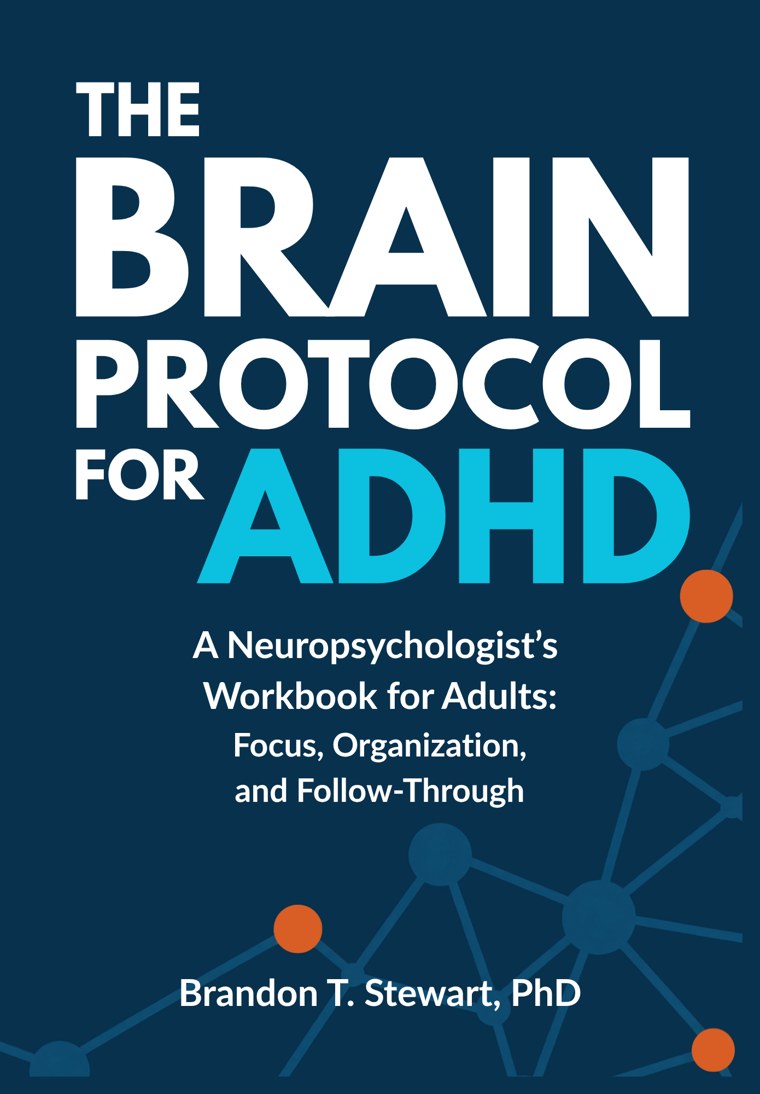
Now in paperback
A Neuropsychologist's Workbook for Adults
The problem was never that you did not try hard enough.
Apps, advice, and planners often fall apart because they assume the problem is motivation. A central challenge with ADHD is at the point of performance, the space between knowing what to do and doing it in the moment it counts.
The BRAIN Protocol is designed for that gap, with a practical, structured way to build systems that work with your brain, not against it. Every claim inside is cited to its primary source, with the limits of the evidence stated plainly.
Paperback, 319 pages, 7 × 10 inches. Want a closer look? See pages from inside. The preview signup opens on Kit, and you can unsubscribe any time.
How the program works
Look. Notice. Steer.
One loop runs through every module. Read one section, try one practice in your real week, look at what happened, and adjust. The work happens between the pages, and not only on them.
Look
Gather a little information about what actually happens in your day. A short log is enough to start.
Notice
Find the pattern. Where does the plan break down, and what seems to help when it holds?
Steer
Choose one adjustment and turn it into a specific if-then plan you can practice this week.
Every module carries a hard-week floor: the smallest version of the practice that still counts. The program is built to survive the weeks that do not go to plan.
Inside the workbook
A place to notice. A system to return to.
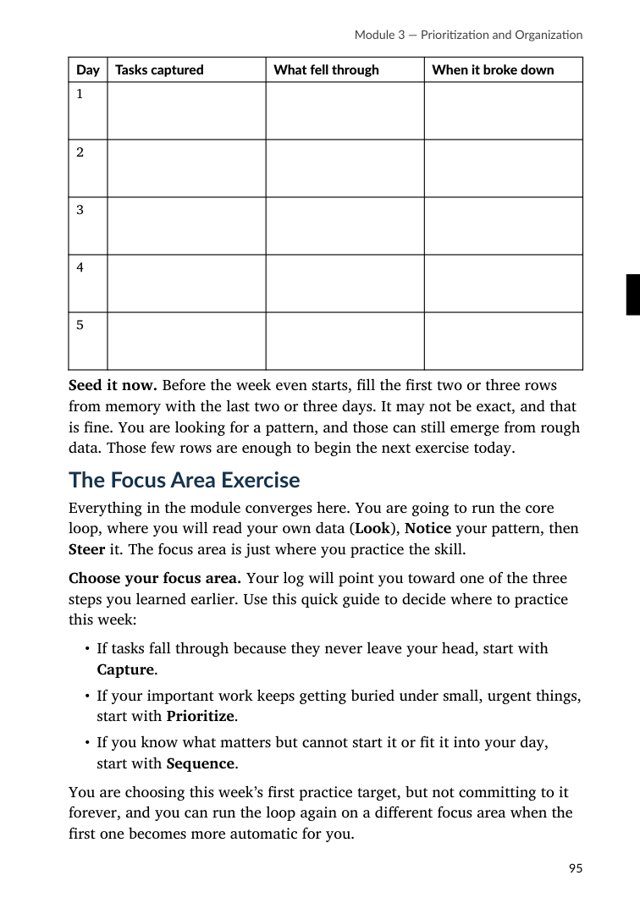
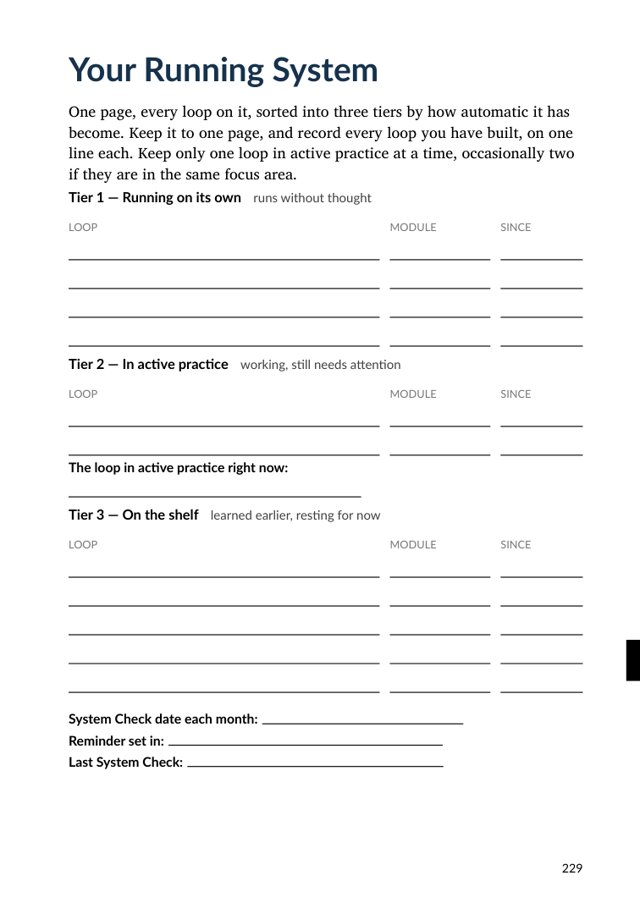
Worked examples, practice logs, and action plans connect each idea to your own days. By the final module you bring your practices together on one page, your Running System, with a way to review it and a way to restart when a loop falls off.
Shown here: actual pages from the workbook.
The path through the book
Eight modules. One practice at a time.
Start with your foundation, then build the skills for the situations that keep showing up.
Foundations of Brain Health, Cognition, and Goal Setting
Your baseline, your values, and where to begin
Metacognition and Brain-Healthy Habits
Noticing your patterns and the six pillars underneath them
Prioritization and Organization
Capture, prioritize, and sequence what comes next
Planning and Prospective Memory
Breaking goals down and remembering to act
Attention and Focus
Preparing to focus, catching drift, and re-engaging
Memory
Encoding what matters and building external supports
Emotional Regulation and Self-Trust
Working with emotion and staying on your own side
Mastery and Maintenance
Keeping, reviewing, and restarting your practices
Clinical experience. Personal understanding.
From someone who knows both sides.
I diagnose ADHD. I also have it.
Brandon T. Stewart, PhD, is a licensed clinical neuropsychologist who also has ADHD, with more than a decade of experience assessing and treating adults who have it. The BRAIN Protocol grew from a cognitive skills training program he co-developed during his postdoctoral fellowship and later evaluated with colleagues in research published in Applied Neuropsychology: Adult.
Its focus is practical: understanding how your brain works, and building systems that keep working on the weeks you cannot.
Inside you will find
Eight guided modules covering ADHD-related skills and systems
Logs, worksheets, two self-assessments, and a values exercise
Twelve optional Deep-Dive guides
A Running System and Restart Plan
Your systems are not training wheels you are meant to outgrow, but permanent equipment built to support how your brain works, and meant to stay in place.
You do not have to do this alone
The communityComing soon
A place to work through the program alongside other adults with ADHD.
People share the if-then they are running, report what happened, and ask questions when a technique does not fit their life. There are no meetings you have to attend and nothing to keep up with, and you can read without posting for as long as you want.
It will be free to join and open to every reader. You do not need to register your copy to take part, and the join link will appear right here the day the doors open.
The community is peer support and shared practice, and it is not clinical care. Nobody there, including me, can diagnose you, treat you, or advise you on medication.
Want an email when it opens? Register your copy and you will hear first.
Ready when you are
Start with one small rep.
The full program is in paperback now. If you would like to try the approach first, the free preview is yours to keep.